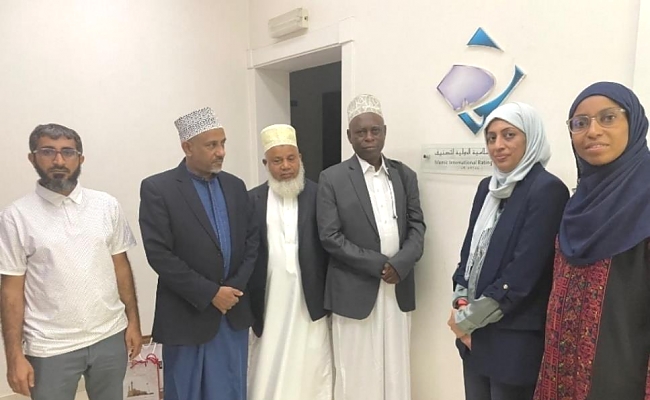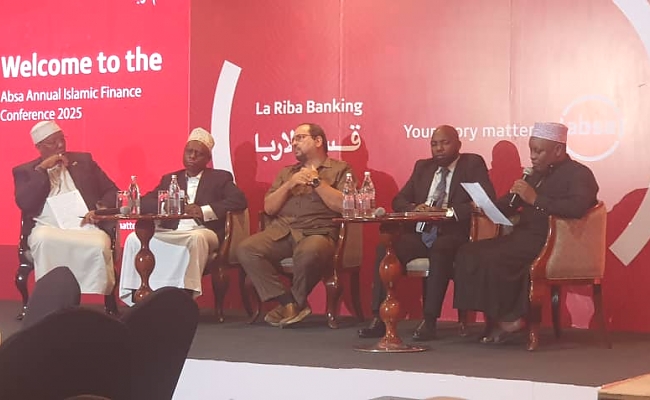
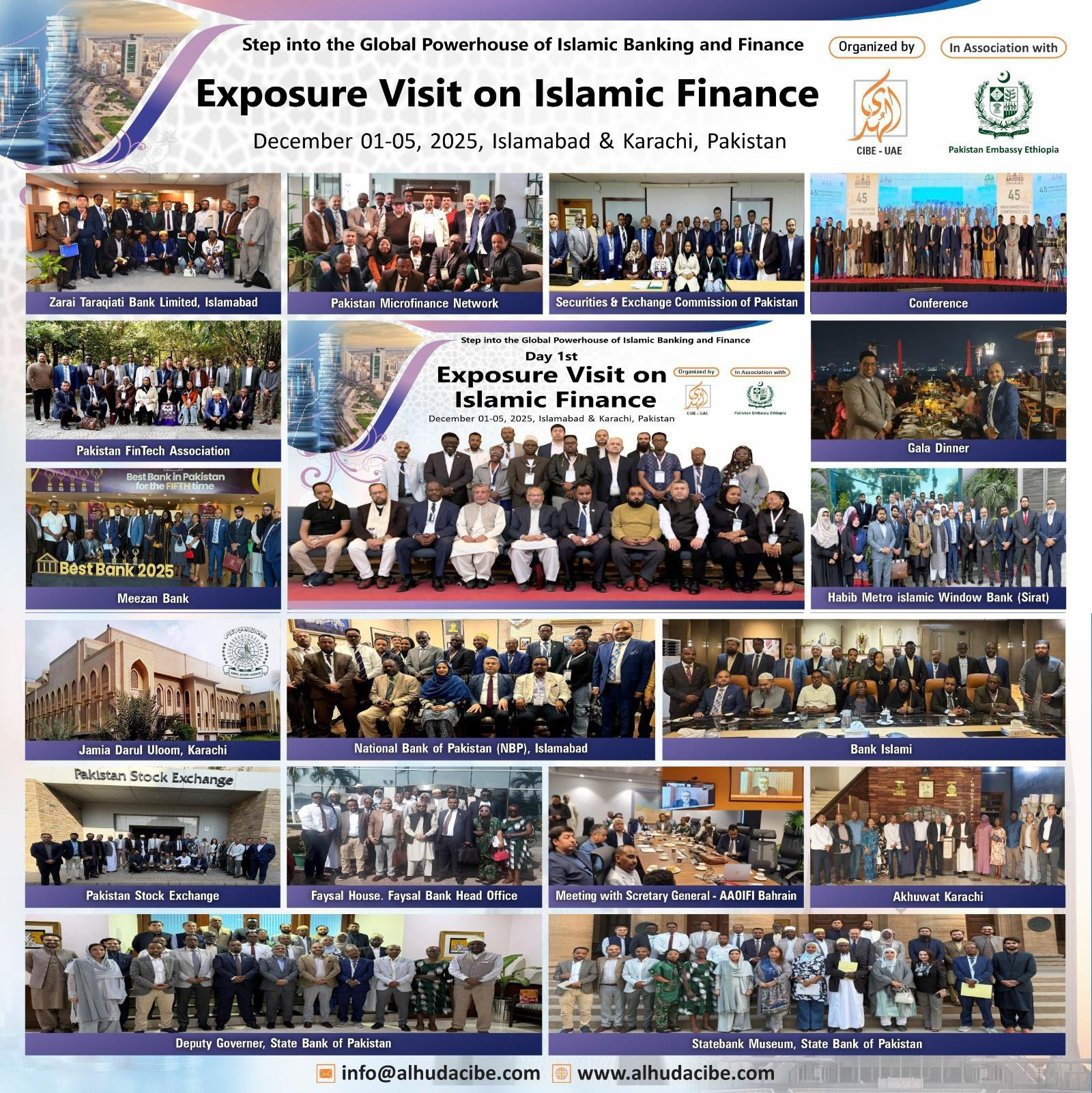
Tanzania Delegate Participation in the Exposure Visit and Executive Training Program on Islamic Finance in Pakistan (1-5 December 2025, Islamabad & Karachi)
Cifca Delegate:
Prof. Mohammed Hafidh Khalfan - Zanzibar Presidential Delivery Bureau (ZPDB)
- Salum Lupande - CIFCA
- Mohammed Hassan Ally - Alpha Halal Fund;
- Badriya Rashid - Amana Bank
- Zulfa Ndauga - Independent Islamic Finance Expert.
Background & Context:
The Centre for Islamic Finance, Compliance and Advice (CIFCA) entered into a strategic Memorandum of Understanding (MoU) with AlHuda Centre of Islamic Banking and Economics (CIBE) in 2021. The MoU was designed to advance:
- Capacity building in Islamic finance
- Shariah governance and advisory excellence
- Exposure of Tanzanian scholars and practitioners to global best practices
As part of operationalizing this MoU, CIFCA facilitated participation of five (5) delegates in the Exposure Visit and Executive Training Program on Islamic Finance in Pakistan (1-7 December 2025, Islamabad & Karachi).
Strategic Objectives
Organization of this exposure visit aimed to:
- Enhance implementation of the CIFCA-AlHuda MoU, moving from agreement to tangible human capital development;
- Benchmark regulatory frameworks (SBP & SECP models);
- Learn Sukuk, Takaful, and Islamic banking operational models;
- Strengthen international institutional linkages; and
- Facilitate knowledge transfer to Tanzania ecosystem.
Major outcome of this visit is the experience that participants from Tanzania had the opportunity learn the most advanced Islamic finance ecosystem, with Pakistan recognized as a rapidly growing hub supported by strong regulatory frameworks and product innovation. Especially that Pakistan stands out globally as one of the few jurisdictions that has:
- A clear national vision to convert the entire financial system into a fully Shariah-compliant system by 2027;
- Strong regulatory dual architecture - State Bank of Pakistan (SBP) for Banking sector, and Securities and Exchange Commission of
- Pakistan (SECP) for Capital markets; and
- A deeply integrated ecosystem covering - Islamic banking, Takaful, Sukuk, Islamic microfinance and Islamic fintech.
Detailed presentation of key objectives and lessons learnt from engagements with various institutions is presented separately below.
Pakistan Microfinance Network (PMN)
Pakistan Microfinance Network is a central industry body coordinating microfinance institutions across the country. It plays a pivotal role in advancing financial inclusion through Shariah-compliant models, particularly targeting underserved populations.
Its relevance to Islamic finance lies in its ability to translate Shariah principles into practical financial inclusion tools, especially for low-income and rural communities. This presents a clear opportunity for Tanzania to develop Islamic microfinance frameworks aligned with national financial inclusion agendas.
Key Objective:
- To understand how Islamic finance can be operationalized as a financial inclusion tool, particularly for underserved populations who are excluded from conventional banking systems.
- To examine the institutional framework through which microfinance institutions deliver Shariah-compliant financing solutions at scale, including governance, outreach, and sustainability models.
- To explore how Islamic microfinance products are structured to align with both Shariah principles and socio-economic development goals
Key Outputs:
- Islamic microfinance in Pakistan demonstrates that financial inclusion can be achieved without reliance on interest-based systems, using instruments such as Qard Hasan, Murabaha, and Mudarabah to support low-income communities.
- The institutional coordination role played by PMN highlights the importance of having a central body that standardizes practices, builds capacity, and advocates for policy support, which is currently a gap in Tanzania’s ecosystem.
- The strong focus on women empowerment and rural financing provides a practical model for Tanzania to design inclusive Islamic finance programs targeting vulnerable groups, particularly in agriculture-driven regions.
Pakistan Fintech Network Background and Context:
The Pakistan Fintech Network represents the intersection of technology and Islamic finance, driving innovation in digital banking, payments, and financial access.
Its importance lies in demonstrating how Islamic finance can evolve beyond traditional banking into digital ecosystems. For Tanzania, where mobile money penetration is already high, the key takeaway is that Islamic finance can leapfrog traditional banking constraints by embedding itself into digital financial services.
Key Objective:
- To explore how financial technology is being integrated into Islamic finance to enhance efficiency, accessibility, and scalability of Shariah-compliant financial services.
- To understand regulatory and operational considerations in developing Islamic digital financial products, including mobile banking, crowdfunding, and peer-to-peer financing.
- To assess how fintech innovation can support financial inclusion and market expansion within a Shariah-compliant framework.
Key Outputs:
- The integration of fintech into Islamic finance demonstrates that digital platforms can significantly lower the cost of delivering Shariah-compliant services, making them accessible to wider populations.
- Pakistan’s experience shows that Islamic fintech can thrive when supported by adaptive regulatory frameworks that balance innovation with Shariah compliance, a key area for development in Tanzania.
Given Tanzania’s leadership in mobile money, there is a clear opportunity to embed Islamic finance into existing digital ecosystems, enabling rapid scaling of Islamic financial services without heavy infrastructure investment.
Zarai Taraqiati Bank Limited (ZTBL)
ZTBL is a specialized agricultural bank integrating Islamic finance into agriculture and rural development, sectors critical to Pakistan's economy.
The visit aimed to explore how Islamic finance structures can support productive sectors such as agriculture, rather than being limited to consumption financing. For Tanzania, this is highly transformative, as agriculture is a backbone of the economy.
Key Objective:
- To understand how Islamic finance can be applied in productive sectors such as agriculture, which are critical to national economic development.
- To examine the structuring and application of Salam and Istisna contracts in financing agricultural inputs and production cycles.
- To assess how Islamic financing models can address sector-specific risks such as seasonality, climate exposure, and income volatility.
Key Outputs:
- The application of Salam and Istisna contracts demonstrates that Islamic finance can be effectively used to finance real economic activity, particularly agriculture, rather than being limited to consumption-based financing.
- ZTBL’s model highlights the importance of aligning financial products with sector realities, ensuring that repayment structures match agricultural income cycles.
- For Tanzania, this provides a clear pathway to develop Islamic agricultural financing schemes, which can enhance productivity, improve farmer resilience, and support national food security objectives.
Securities and Exchange Commission of Pakistan (SECP)
- SECP is the primary regulator of capital markets, playing a central role in developing Islamic capital markets, Sukuk frameworks, and investment
- For Tanzania, this visit aimed to provide a blueprint for: CMSA regulatory frameworks; Sukuk market development; and Investor confidence
- To analyze how a capital markets regulator can actively develop and supervise Islamic financial markets, including Sukuk and Shariah-compliant investment products.
- To understand the implementation of Shariah Governance Frameworks and regulatory standards for Islamic financial institutions.
- To explore mechanisms for ensuring market transparency, investor protection, and Shariah compliance.
Key Outputs:
- SECP’s proactive role demonstrates that regulatory bodies can be key drivers of Islamic finance growth, rather than merely supervisory institutions.
- The establishment of structured Shariah governance frameworks ensures consistency, credibility, and investor confidence, which are essential for market development.
- Tanzania can leverage these lessons to strengthen CMSA frameworks, particularly in developing Sukuk regulations and Shariah-compliant capital market instruments.
National Bank of Pakistan - Islamic Window (Aitemaad)
Key Objective:
- To understand how Islamic banking can be integrated within conventional banking institutions through Islamic windows.
- To examine operational, governance, and product structuring considerations for delivering Shariah-compliant services within dual banking systems.
- To explore how banks manage customer transition from conventional to Islamic banking services.
Key Outputs:
- The Islamic window model demonstrates a practical and scalable approach for introducing Islamic banking without requiring full institutional transformation.
- The integration of Islamic services within conventional banks allows for rapid market penetration while maintaining operational efficiency.
- For Tanzania, this provides a realistic pathway for existing banks to expand Islamic offerings, thereby accelerating market development without structural disruption.
Meezan Bank Limited
- Meezan Bank is Pakistan’s flagship full-fledged Islamic bank, widely regarded as a benchmark institution globally. For Tanzania, this visit provided
- To gain insights into the operational model of a full-fledged Islamic bank, including governance, product development, and customer
- To understand how Islamic banks ensure continuous Shariah compliance across all operations and product lines.
- Meezan Bank demonstrates that success in Islamic banking requires a strong institutional commitment to Shariah governance and product
- The bank’s customer-centric approach shows that Islamic finance can compete effectively with conventional banking when products are designed around real market needs.
- Tanzania can draw from this model in planning for full-fledged Islamic banks, ensuring strong governance structures and market-responsive product development.
Jamia Darul Uloom Karachi
- To understand the role of Islamic academic institutions in developing qualified Shariah scholars for the financial sector.
- To explore how Shariah scholarship is integrated into financial governance and product approval processes.
- To assess the importance of structured training programs in building Shariah advisory capacity.
- The visit highlighted that a strong Islamic finance ecosystem depends on a robust pipeline of well-trained Shariah scholars.
- The integration of academic institutions with the financial sector ensures consistency and credibility in Shariah rulings and governance.
- Tanzania must invest in developing local Shariah scholars and training institutions, ensuring sustainability and independence of its Islamic
Pakistan Stock Exchange (PSX)
Key Objective:
- To understand the role of capital markets in supporting Islamic finance through Sukuk issuance and Shariah-compliant securities trading.
- To explore regulatory and operational frameworks for listing and trading Islamic financial instruments.
- To assess investor demand and market dynamics for Shariah-compliant investments.
Key Outputs:
- The PSX experience demonstrates that Sukuk can be a powerful instrument for mobilizing long-term capital while adhering to Shariah principles.
- The development of Islamic capital markets requires strong regulatory support, investor awareness, and product standardization.
- For Tanzania, this directly supports efforts to develop Sukuk markets through the DSE, particularly in relation to government and quasi-sovereign issuances.
State Bank of Pakistan (SBP
SBP is the central driver of Islamic finance policy and regulation, ensuring alignment between national vision and market implementation. SBP’s role demonstrates that Central banks must be active promoters, not passive regulators, ad Policy clarity accelerates market growth.
For Tanzania, this underscores the need for Dedicated Islamic finance frameworks within BoT, and Strategic policy direction.
Key Objective:
- To examine the role of a central bank in leading the strategic development and regulation of Islamic finance.
- To understand policy tools and frameworks used to promote Shariah-compliant banking systems.
- To explore approaches for integrating Islamic finance into the national financial architecture.